You just got an Android phone - or maybe you've had one for years. Either way, there's a good chance your settings are still at factory defaults. That means your battery drains faster than it should, apps are quietly tracking your location, and your phone isn't nearly as fast or secure as it could be.
10 Android Settings You Should Change Right Now
You just got an Android phone - or maybe you've had one for years. Either way, there's a good chance your settings are still at factory defaults. That means your battery drains faster than it should, apps are quietly tracking your location,...
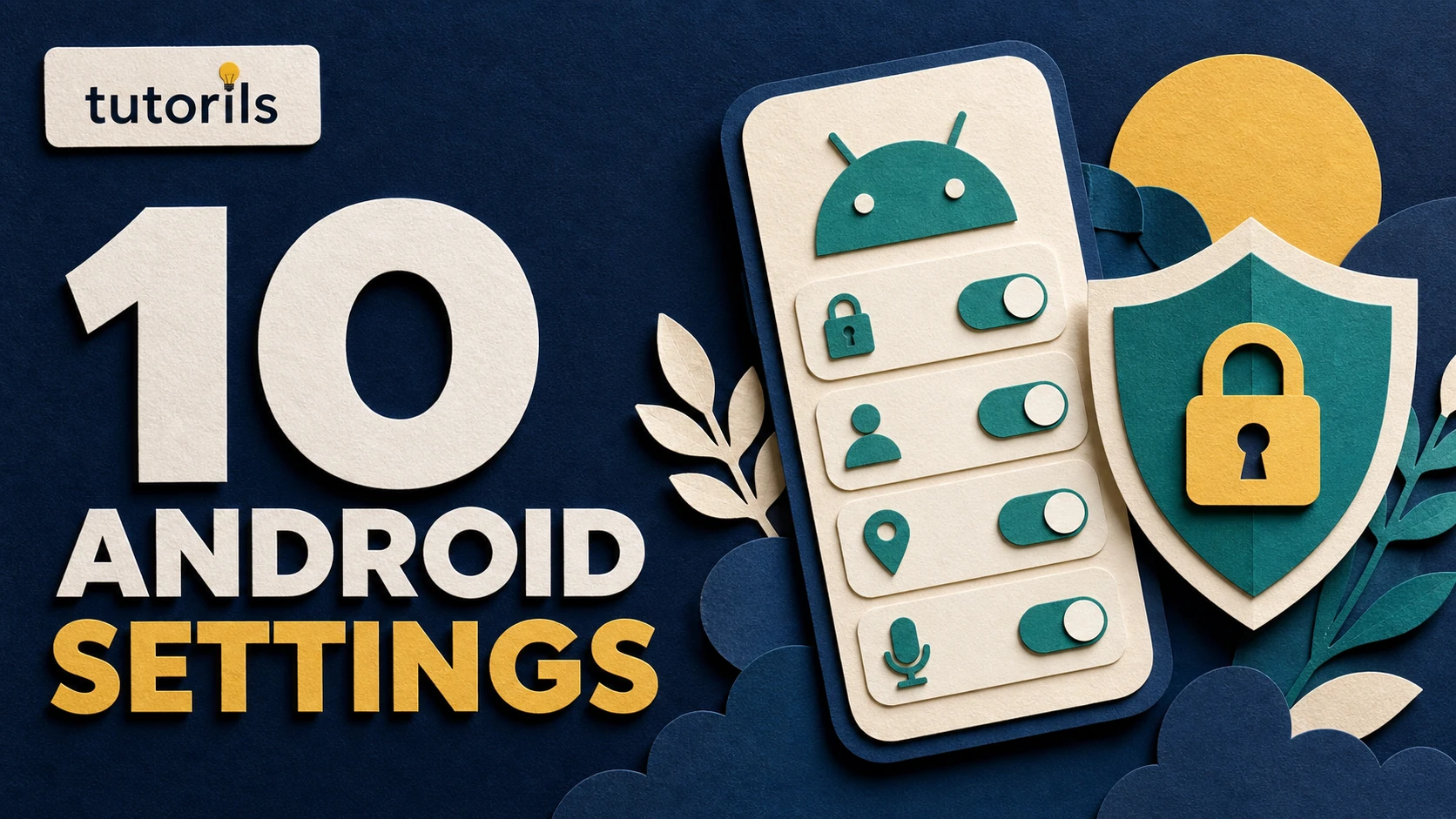
Realistic guide image for this Tutorils tutorial.The good news? A few quick tweaks can completely transform your experience. In this guide, Tutorils walks you through the 10 Android settings you should change right now - no technical knowledge required. Just follow the steps and enjoy a faster, safer, smarter phone.
Whether you're on a Samsung, OnePlus, Xiaomi, or stock Android device, most of these settings apply to all Android phones running Android 10 and above.
Why Default Android Settings Aren't Good Enough
Android is the world's most popular mobile operating system, but out of the box, it's configured for convenience - not necessarily for you. Manufacturers and app developers benefit when permissions are wide open and features like location and background data are always on.
Changing a handful of settings takes less than 10 minutes but pays off every single day in battery life, privacy, speed, and peace of mind. Let's dive in.
- Turn Off Location Access for Apps That Don't Need It
This is the single most impactful privacy change you can make. Many apps request "Always On" location access even when they don't need it - think shopping apps, games, and social media.
How to do it:
- Go to Settings ? Privacy ? Permission Manager
- Tap Location
- Review each app - change "Allow all the time" to "Only while using" or "Deny" for apps that don't need GPS
Pro Tip: Only navigation apps like Google Maps genuinely need "Always On" location. Everything else can use "Only while using the app."
- Enable Google Play Protect
Google Play Protect is Android's built-in malware scanner. It checks all your apps - even ones from outside the Play Store - for harmful behavior. Surprisingly, many users have it turned off without knowing.
How to enable it:
- Open the Google Play Store
- Tap your profile picture (top right)
- Tap Play Protect ? Settings
- Toggle on "Scan apps with Play Protect"
This runs silently in the background and alerts you if any app behaves suspiciously. It's free, built-in, and essential.
- Set Up a Strong Screen Lock
If your phone is still using a 4-digit PIN or swipe pattern, you're leaving the door wide open. In 2025, the minimum recommended lock is a 6-digit PIN or better yet, a strong alphanumeric password combined with fingerprint unlock.
How to set it:
- Go to Settings ? Security ? Screen Lock
- Choose Password (alphanumeric) or at minimum a 6-digit PIN
- Also enable Fingerprint or Face Unlock for convenience under Settings ? Biometrics
A strong lock screen is your first line of defense if your phone is ever lost or stolen.
- Disable App Permissions You Never Agreed To
Apps love asking for permissions - microphone, camera, contacts, SMS. Many of these are granted during installation and never revisited. Time for a full audit.
How to audit permissions:
- Go to Settings ? Privacy ? Permission Manager
- Go through each permission type: Camera, Microphone, Contacts, SMS, Files
- Revoke access for any app that doesn't clearly need it
For example - does your calculator app really need microphone access? Probably not. Revoke it.
Android Privacy & Security - Lock down your permissions5. Turn Off Ad Personalization
Google uses your activity to serve personalized ads across apps and websites. You can opt out of this without affecting any app functionality.
Steps:
- Go to Settings ? Google ? Ads
- Tap "Delete advertising ID" (Android 12+) or toggle "Opt out of Ads Personalization"
- Confirm when prompted
This won't stop ads entirely, but they'll no longer be based on your personal behavior. A small win for privacy that takes 30 seconds.
- Optimize Battery with Adaptive Battery
Android's Adaptive Battery feature uses machine learning to learn your usage habits and restrict battery for apps you rarely use. It's one of the easiest battery life improvements available.
How to enable:
- Go to Settings ? Battery ? Adaptive Battery
- Toggle it ON
- Also check Battery Usage for apps draining power in the background
Pair this with Dark Mode (Settings ? Display ? Dark Theme) to squeeze even more battery life, especially on AMOLED screens.
Battery & Performance - Squeeze more life from your Android7. Restrict Background Data for Apps
Many apps constantly sync data in the background - eating your mobile data and draining your battery. You can restrict this per app.
How to do it:
- Go to Settings ? Apps
- Select any app you want to restrict
- Tap Mobile Data & Wi-Fi
- Toggle off "Background data"
Do this for social media apps, news apps, and any app you don't need real-time updates from. Your data bill will thank you.
- Enable Two-Factor Authentication on Your Google Account
Your Google account is the master key to everything on your Android phone - emails, photos, contacts, payments. Protect it with two-factor authentication (2FA).
How to enable:
- Go to Settings ? Google ? Manage your Google Account
- Tap the Security tab
- Under "How you sign in to Google," tap 2-Step Verification
- Follow the setup steps - use Google Authenticator or a phone prompt
Even if someone gets your password, they can't access your account without the second factor. This is non-negotiable in 2025.
- Use DNS Over HTTPS for Safer Browsing
This is a slightly advanced but very powerful setting. DNS over HTTPS (DoH) encrypts your DNS queries, meaning your internet provider can't easily track which websites you visit.
How to enable:
- Go to Settings ? Network & Internet ? Private DNS
- Select "Private DNS provider hostname"
- Enter: dns.google or 1dot1dot1dot1.cloudflare-dns.com
- Tap Save
This protects you on both home Wi-Fi and public hotspots. Cloudflare's DNS (1.1.1.1) is one of the fastest and most private options available.
- Enable Developer Options for Better Performance (Optional)
This one's for users who want to squeeze every drop of performance. Developer Options unlocks animation speed controls that make your phone feel significantly snappier.
How to enable Developer Options:
- Go to Settings ? About Phone
- Find Build Number and tap it 7 times rapidly
- Enter your PIN if prompted - Developer Options is now unlocked
Speed up animations:
- Go to Settings ? Developer Options
- Find Window animation scale, Transition animation scale, Animator duration scale
- Set all three to 0.5x
Your phone will feel twice as fast - not because it actually is, but because the animations complete in half the time. Every Android enthusiast does this.
Quick Summary Table
#SettingBenefit1Location AccessPrivacy2Play ProtectSecurity3Strong Screen LockSecurity4App Permissions AuditPrivacy5Ad Personalization OffPrivacy6Adaptive BatteryBattery Life7Restrict Background DataData & Battery8Google 2FASecurity9Private DNSPrivacy & Speed10Developer OptionsPerformance
What's New in Android in 2025
Android 15 and the upcoming Android 16 bring several new privacy and security features worth knowing about:
- Theft Protection: Android now detects sudden snatching motions and locks the screen automatically
- Private Space: A hidden, locked zone for sensitive apps (like banking apps) - set it up under Settings ? Security ? Private Space
- Health Connect: Unified health data permissions so fitness apps can't over-collect your data
- Notification Cooldowns: Android automatically reduces notification spam from chatty apps
Stay updated - each Android version tightens security and gives you more control. Always keep your phone on the latest update via Settings ? System ? System Update.
External Resources
Check the result on the actual destination
Do not judge 10 android settings you should change right now only from the editing or setup screen. Open the saved result where it will actually be used. A file may look correct in an editor but fail after export. A setting may appear enabled but apply only to one profile. A cloud item may exist on one device but not be available offline. A published page may look fine on a desktop and become difficult to read on a narrow screen.
Use the verification method that matches the goal. Look for a repeatable test that confirms the setting, file, connection, speed, or security state changed as intended. Refresh the destination, sign in again if appropriate, and test from another supported device when the task involves syncing or public access. For a submitted form or payment, rely on the official confirmation and account history rather than a screenshot from an intermediate screen. If the result is incomplete, return to the last confirmed stage. Do not repeat the entire process until you know which stage failed.
Troubleshoot the exact failure, not the whole task
When 10 android settings you should change right now does not work, record the exact message and the step that produced it. Check the internet connection, available storage, app or browser version, account, permissions, file format, and required fields. Then repeat only that step. Restarting the entire process can hide the original cause and may create duplicate drafts, uploads, submissions, or charges.
Search the device maker, operating system, app, or service provider support documentation with the exact feature or error text. Be cautious with old forum answers because menus, eligibility rules, and product limits change. If the issue concerns a public service, bank, payment, identity document, or tax record, use the official support channel and keep the reference number. If it concerns a device or creative file, test a copy before deleting caches, resetting settings, or reinstalling software. Escalate with useful evidence: device and version, time, step, error text, and the checks already completed.
Keep proof without keeping unnecessary private data
A good record for 10 android settings you should change right now helps with later support and maintenance. Save the final file, confirmation, reference number, approved link, version name, or settings note in a location you can find. Use a filename that includes the subject and a clear date when versions matter. Do not rely on a browser download list or a temporary notification as the only proof.
Keep the record proportionate to the task. A public design file may need an editable master and an exported copy. A device change may need only a note of the original setting. A formal submission may require the official receipt and acknowledgement. Remove screenshots that expose addresses, identification numbers, account balances, or private messages after the issue is resolved. Store sensitive records in a protected account or encrypted device, and limit sharing to the person or organization that genuinely needs them.
Build a repeatable checklist for next time
After completing 10 android settings you should change right now, turn the successful path into a short checklist. Include the correct account, required inputs, official starting page, important choices, verification method, and storage location for the result. Remove exploratory steps that did not contribute. A concise checklist reduces effort the next time without encouraging blind repetition.
Add a reminder for the parts that can change, such as interface labels, eligibility rules, export sizes, pricing, permissions, software versions, or platform policies. Link to the device maker, operating system, app, or service provider support documentation rather than copying a rule that may become outdated. If the process belongs to a team, identify who owns the source material, who reviews the result, and who can approve publication or submission. The checklist should help a careful beginner complete the work, but it should still tell them where judgment or official verification is required.
Related Tutorils guides
Reader answers
Frequently asked questions
Open a question to read the answer. Opening another answer closes the previous one.
What is the best way to start 10 android settings you should change right now?
Start with the preparation section in this guide. Confirm the goal, collect the required information, and use the official device, operating system, or app named in the article. Make one controlled change at a time so you can identify which step produced the result.
Can a beginner follow this 10 android settings you should change right now guide?
Yes. Read the full sequence once before acting, then follow the steps in order. Do not skip backups, account checks, or verification steps. If a label differs on your screen, consult the device maker, operating system, app, or service provider support documentation before choosing.
What should I prepare before working on 10 android settings you should change right now?
Prepare the account, device, documents, files, or source material named in the guide. Save a backup where relevant, confirm internet access, and keep recovery details available. For sensitive tasks, work on a trusted device and private connection.
How long does 10 android settings you should change right now usually take?
The time depends on the device, account, file size, approval process, and connection speed involved. Allow extra time for verification or syncing. A careful first attempt is usually better than rushing and having to repeat the work.
Is 10 android settings you should change right now safe to do?
Use the official device, operating system, or app named in the article, review permissions, and protect private information. Watch for deleting useful data, changing the wrong setting, or granting unnecessary access. Stop if a page, message, or permission request does not match this guide.
What if the options for 10 android settings you should change right now look different?
Interfaces change and some options vary by device, account type, region, or software version. Check the current official help page, search the settings menu for the named feature, and avoid selecting a substitute option until its purpose is clear.
How do I know whether 10 android settings you should change right now worked?
Use the verification step in this guide and check for a repeatable test that confirms the setting, file, connection, speed, or security state changed as intended. Test the outcome with a small, low-risk example when possible. Keep the confirmation page, reference number, or before-and-after.
What should I do if 10 android settings you should change right now does not work?
Recheck the prerequisites, spelling, account, connection, permissions, and software version. Repeat only the failed step. Record the exact error message, then use the device maker, operating system, app, or service provider support documentation or the provider's official support channel for that specific error.
Can I undo changes made during 10 android settings you should change right now?
Some changes can be reversed, while submissions, deletions, payments, or account actions may not be. Read each confirmation screen before continuing. Use the rollback or recovery guidance in the article and keep a backup before changing important data.
How can I keep 10 android settings you should change right now accurate over time?
Review the setup after major updates and whenever the service changes its interface or policy. Recheck permissions, saved details, links, and results. Use the article's updated date together with the device maker, operating system, app, or service provider support documentation for the latest instructions.