
"Get organized" sounds like a goal, but it does not tell you what to do on Tuesday evening. "Learn design" has the same problem. Both describe a direction without defining a visible result, a suitable next action, or a time when work will begin.
How to Turn a Vague Goal Into Weekly Actions
Turn one broad goal into a realistic weekly milestone, visible actions, calendar time, an if-then backup, and a short evidence-based review.
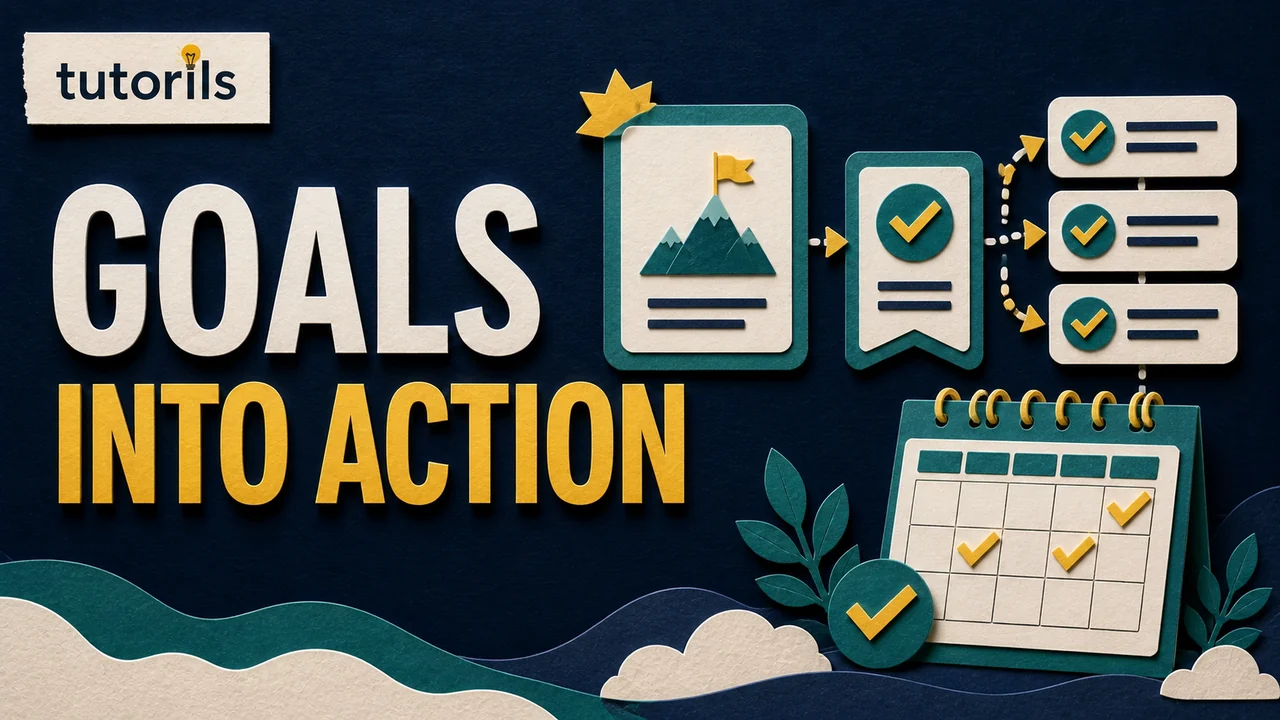
A weekly action plan closes that gap. It turns one broad outcome into a milestone that fits the coming week, then converts the milestone into a few actions you can place in real time. The plan remains flexible because you review it after seven days and adjust it using what actually happened.
This is a productivity method, not a promise that planning guarantees success. Goals can depend on money, health, other people, changing priorities, and events outside your control. The method is useful because it makes the next attempt specific enough to start and easy enough to review.
Identify why the goal is still vague
A vague goal usually hides one or more unanswered questions:
- What would be different if the goal were achieved?
- Which part matters now?
- What evidence would show progress this week?
- What is the next action a person can physically perform?
- When and where could that action happen?
Write the goal at the top of a page and underline every word that can mean several things. "Improve my portfolio" could mean selecting projects, rewriting case studies, taking new photographs, fixing navigation, or asking for feedback. Until you choose, the brain must make that decision every time you try to begin.
Do not solve the problem by adding a distant deadline alone. "Improve my portfolio by December" gives you a date but still no action. First define the outcome, then choose what the current week can contribute.
Define the outcome in plain language
Rewrite the goal as a result you could recognize. Use ordinary language rather than motivational wording.
Vague: Build a better online presence.
Clearer outcome: Publish a portfolio with four current projects, a short biography, and a working contact form.
Vague: Become better at spreadsheets.
Clearer outcome: Complete a monthly budget workbook that uses formulas, filters, and one summary chart without copying a finished template.
The outcome does not need to predict every detail. It needs a finish line that helps you choose actions. Ask what must exist, work, change, or be decided.
Check whether the goal still belongs to you. A plan will not fix a target you accepted only because someone else expected it. If the outcome no longer matters, revise or remove it rather than creating an elaborate system to force progress.
Choose one weekly milestone
A weekly milestone is a meaningful piece of the outcome that can reasonably be completed or clearly advanced within seven days. It is larger than a single action and smaller than the full goal.
For the portfolio example, possible milestones include:
- choose the four projects
- write the first project case study
- build the contact page
- review the mobile layout
Choose one primary milestone. You can still handle routine responsibilities, but the goal should not produce six competing priorities. One milestone gives the week a clear test: did this part move forward?
Write the milestone as a result. "Work on portfolio" describes activity. "Select four projects and collect their final images" describes an outcome that can be checked.
The milestone should fit the week you actually have, not an imaginary week with no travel, meetings, family needs, or recovery time. Look at the calendar before committing.
The Tutorils guide to a simple weekly planning system shows how to combine priorities, appointments, and maintenance work without turning the plan into a second job.
Break the milestone into visible actions
An action should start with a verb and describe something you can do in one working session. "Website" is not an action. "List every portfolio page" is.
For "select four projects and collect their final images," actions might be:
- List every project completed in the last two years.
- Score each project for relevance, quality, and permission to share.
- Choose four projects and one backup.
- Locate the final images and copy them into named folders.
- Record any missing permission or file request.
Each step produces evidence. A list, score, selected set, folder, or request exists when the action is done. That makes progress easier to review than a feeling such as "I focused well."
Keep the list small. If it contains twenty actions, the milestone is probably too large or the actions are too detailed. Group mechanical steps that happen together, but separate tasks that require different people, tools, or locations.
Find the true next action
Plans often stall because the first listed action is not actually possible yet. "Write the case study" may depend on finding the project files, confirming results, and receiving permission from a client.
Ask: What must happen before I can begin this action without stopping to search or decide?
If the answer reveals a dependency, write that dependency as the next action. Examples:
- email the project owner to request permission
- find the final approved PDF in the archive
- create a blank document with the required headings
- confirm the meeting date with the reviewer
This is not procrastination through preparation. Limit setup to the information or access that the real task requires. Color-coding a folder system for two hours is not necessary preparation for writing one paragraph.
Estimate effort honestly
Estimate how much focused time each action needs, then compare the total with the space available this week. Include setup, communication, and review. A task that requires "one hour" of writing may also require thirty minutes to find source files and twenty minutes to export and check the result.
Use ranges when the work is uncertain. A first draft might need 60 to 90 minutes. Schedule the larger number if missing the finish would disrupt the next step.
Do not fill every free block. Interruptions and routine work will occur. A weekly plan needs spare capacity so one delay does not make the whole system feel broken.
If the actions do not fit, reduce the milestone. Selecting projects this week and collecting assets next week is better than pretending both will happen and carrying the same unfinished list forward.
The guide to calendar blocking without overscheduling explains how to reserve focused time while protecting gaps for ordinary life and unexpected work.
Put actions into a real context
An action is more likely to start when the plan identifies a time and place. "Draft the introduction this week" leaves the start undecided. "Draft the introduction at the desk after Tuesday's first coffee" provides a cue.
Researchers Peter Gollwitzer and Veronika Brandstätter distinguished broad goal intentions from implementation intentions, which connect a planned behavior to an anticipated situation. Their 1997 paper on implementation intentions and effective goal pursuit reported that these plans supported the initiation and completion of difficult goal-directed actions in the studies they examined.
A practical format is:
When situation X occurs, I will perform action Y.
Examples:
- When I sit down at 7:00 p.m. on Tuesday, I will score the project list for 30 minutes.
- When Thursday's team call ends, I will send the permission request before opening another app.
- When I enter the library on Saturday, I will complete the first two spreadsheet exercises.
The cue should be specific and likely to occur. The action should be under your control. "When the client approves everything" is not a useful cue because another person controls it.
Implementation intentions support action initiation. They do not guarantee the goal, make an unrealistic workload possible, or remove the need to adapt.
Write one if-then backup plan
Choose the obstacle most likely to disrupt the milestone and decide what you will do if it occurs.
Examples:
- If Tuesday's work session is lost, then I will use Thursday's protected backup block.
- If the project owner does not reply by Friday, then I will prepare the backup project instead.
- If the library is closed, then I will complete the exercise at the kitchen table with notifications disabled.
One backup is usually enough. Writing a branching plan for every possible problem becomes another form of avoidance. Pick a predictable obstacle, not an extreme scenario.
The backup should preserve the purpose of the action. If the planned research session fails, replacing it with cleaning the desktop may feel productive but does not move the milestone.
Match difficult work to available energy
Time on a calendar is not the same as usable attention. Place demanding work in periods when you are usually able to think clearly. Use lower-energy periods for file collection, simple edits, scheduling, or messages.
Do not claim a universal perfect time of day. Some people work well early, some later, and many have schedules they cannot choose. Review your own recent weeks for evidence: when did focused work actually happen, and what conditions helped?
The Tutorils guide to planning focused work around real energy provides a method for matching task difficulty with the capacity your week offers.
Keep the start small when resistance is high. Opening the source file and writing one rough paragraph can be a valid first session. The purpose is to begin the real task, not to lower every standard permanently.
Track evidence rather than mood alone
At the end of each work block, record what exists now:
- four projects selected
- two permission requests sent
- 600 words drafted
- twelve transactions categorized
- three lessons completed and checked
Mood matters because frustration, boredom, and exhaustion affect the next plan. It should not be the only progress measure. You can feel unproductive after a difficult session that produced the exact decision the project needed.
Use a short note beside each action: done, moved, dropped, or blocked. If blocked, name the dependency. This provides better review material than repeatedly copying unfinished tasks without explanation.
Avoid tracking so many metrics that maintaining the tracker becomes the project. One milestone, a few actions, and a short result note are enough for most personal goals.
Run a weekly review
At the end of the week, answer five questions:
- What evidence shows progress?
- Which action did not happen, and why?
- Was the milestone realistic for the available time and energy?
- Does the overall goal still matter in its current form?
- What is the next weekly milestone?
Use the answers to adjust the system. If actions repeatedly take twice as long as expected, change future estimates. If the same dependency blocks progress, make resolving it the milestone. If the goal has lost relevance, close it deliberately.
A reliable weekly review can combine this goal check with calendar, task, and file maintenance in a short repeatable routine.
Do not punish a missed week by doubling the next one. Move only the work that still matters and fits. Carrying every unfinished item forward creates a backlog that hides the new priority.
Three example transformations
Learning goal
Vague goal: Learn spreadsheet automation.
Recognizable outcome: Build a monthly report that imports one data file, cleans it with repeatable steps, and produces a checked summary table.
This week's milestone: Import the sample file and document the cleaning rules.
Actions: choose the sample, list data problems, import it, apply the first cleaning steps, and compare the output with the original.
Implementation intention: When I open the laptop at the library on Wednesday, I will work through the import process for 45 minutes.
Backup: If the sample file is incomplete, then I will create a small representative file and continue the workflow test.
Work project
Vague goal: Improve team documentation.
Recognizable outcome: Publish a current onboarding guide that a new colleague can follow without asking for missing access or setup steps.
This week's milestone: Map the existing onboarding process and identify missing instructions.
Actions: collect current documents, follow the process in order, record gaps, and ask one recent hire where they became stuck.
Implementation intention: When Monday's planning meeting ends, I will reserve 30 minutes to collect the current documents.
Backup: If the recent hire is unavailable, then I will send the questions by email and continue mapping the documented steps.
Home project
Vague goal: Organize the spare room.
Recognizable outcome: Create a usable desk area, labeled storage for items that remain, and a clear route to the window.
This week's milestone: Clear and set up the desk zone.
Actions: remove items from the desk, sort them into keep or relocate groups, clean the surface, connect the required equipment, and return only daily-use items.
Implementation intention: When breakfast is finished on Saturday, I will sort the desk items for 40 minutes.
Backup: If a decision about an item takes more than two minutes, then I will place it in one review box and continue clearing the surface.
Your one-page weekly action plan
Use this compact structure:
- Goal outcome: What recognizable result are you working toward?
- Weekly milestone: What meaningful part can move this week?
- Actions: Which three to five visible steps produce that milestone?
- Time and context: When and where will each action start?
- Backup: What will you do if the most likely obstacle appears?
- Evidence: What will exist when the week is complete?
- Review: When will you decide the next milestone?
Keep the plan where you will see it during the week. A simple note or paper sheet is enough. The value comes from the decisions it records, not the software used to display them.
A vague goal becomes workable when the current week has one result, a few visible actions, and a specific start cue. Review the evidence after seven days, then make the next plan from reality rather than from the version of the week you hoped to have.
Reader answers
Frequently asked questions
Open a question to read the answer. Opening another answer closes the previous one.
Why are vague goals difficult to act on?
They describe a direction without defining a visible result, next action, or starting cue. Each work session begins with another decision, which makes delay and distraction more likely.
How do I turn a goal into a weekly milestone?
Define the recognizable outcome, review the week you actually have, and choose one meaningful piece that can be completed or clearly advanced within seven days.
How many weekly actions should I choose?
Three to five visible actions are enough for many personal goals. If the list is much longer, reduce the milestone or group mechanical steps that happen in one session.
What makes an action step specific enough?
It starts with a verb, can be performed in one working session, and produces visible evidence such as a list, draft, message, decision, checked file, or scheduled appointment.
How do I estimate whether a weekly plan is realistic?
Estimate focused time plus setup, communication, and review. Compare the total with your real calendar and energy, then keep spare capacity for routine work and interruptions.
What is an implementation intention?
It is a plan that connects a specific situation with a goal-directed action, often written as when or if situation X occurs, I will perform action Y.
How do I write an if-then plan for a goal?
Choose the most likely obstacle and name a practical response that preserves the original purpose. Keep the cue specific and make sure the response is under your control.
Should every weekly action go on my calendar?
Schedule actions that need protected time, coordination, or a firm starting cue. Small flexible tasks can remain on a short list, but they still need a clear context for completion.
What should I do when I miss a weekly milestone?
Review why it was missed, keep only work that still matters, and reduce the next commitment if the estimate was unrealistic. Do not double the following week as punishment.
How often should I review a long-term goal?
Review weekly actions every seven days and revisit the broader goal when priorities, resources, or conditions change. Revise or close a goal that is no longer relevant.