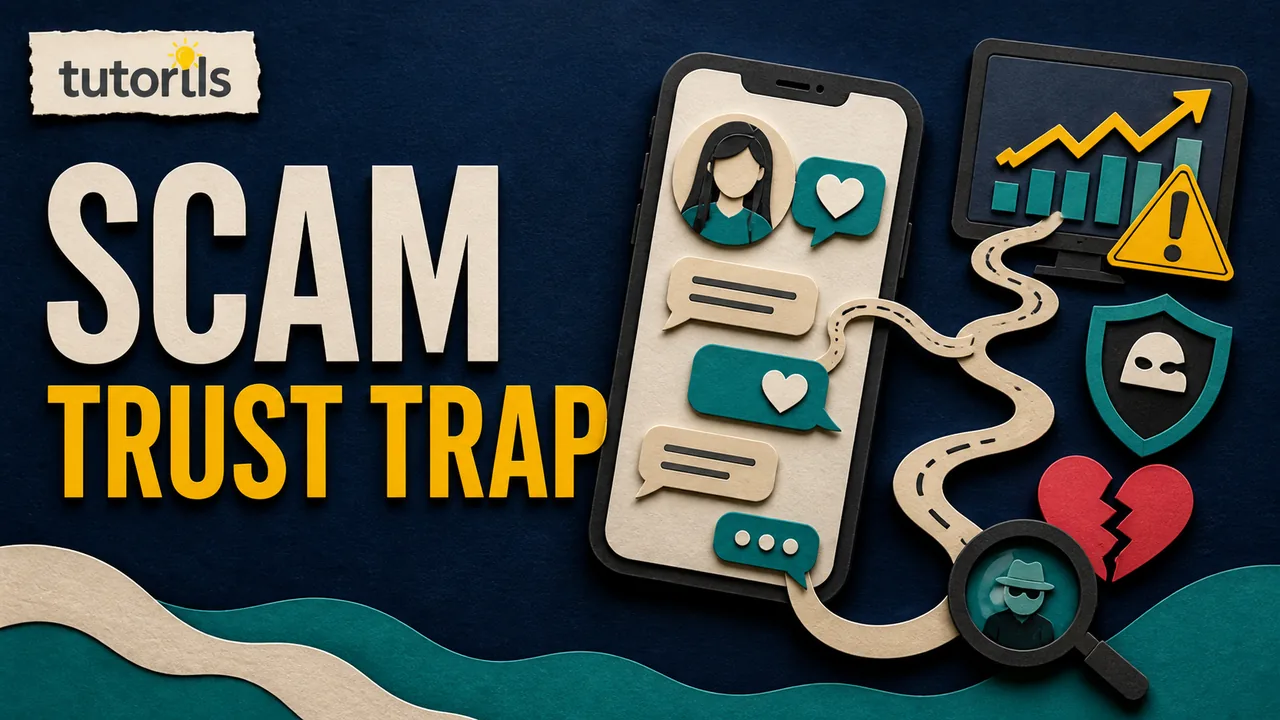
An unexpected message can feel harmless. The sender may say they noticed your profile, share a mutual interest, or want to continue a conversation from a dating app. Nothing about the first exchange mentions money. That delay is part of the risk. A blended romance and investment scam builds familiarity first, then turns the relationship into a reason to trust a financial recommendation.
How AI Scam Networks Combine Romance and Investment Fraud
Learn how blended romance and investment scams build trust, introduce fake financial opportunities, and pressure targets into sending money or account information.
Artificial intelligence can help a criminal operation write messages, translate conversations, invent personas, and produce convincing promotional material. It does not make every polished message fraudulent, and awkward grammar is no longer a dependable safety test. The useful question is whether the person is asking you to trust an identity, platform, return, or payment that you cannot verify independently.
On August 4, 2026, OpenAI reported that it had disrupted a coordinated network of accounts linked to a Cambodia-based operation. According to the company, the network used ChatGPT to support fake personas and investment, romance, gambling, and law-enforcement impersonation schemes. OpenAI said the operation may have interacted with hundreds of targets, but it could not independently verify the loss claims found in the scammers' conversations. That limit matters. The report documents tactics and account activity, not the full size of the crime.
This guide uses the OpenAI case to explain how blended scams work, what warning signs deserve attention, and what to do before or after money is sent. It does not ask you to identify whether a message was written by AI. That is rarely necessary. You can make a safer decision by checking the behavior and the requested transaction.
Why romance and investment fraud work together
Romance fraud and investment fraud solve different problems for the scammer. A romantic or friendly relationship creates trust, privacy, and emotional commitment. A fake investment creates a reason to transfer money repeatedly. When the two are combined, a financial request can feel like advice from someone who cares about you rather than a sales pitch from a stranger.
The U.S. Federal Trade Commission says romance scammers may meet targets on dating sites, social media, or gaming platforms, then move the conversation and eventually ask for money or promote cryptocurrency investing. The FTC's romance scam guidance advises people not to send money or gifts to an online love interest they have not met in person. Meeting once is not enough to prove that an investment platform is legitimate, so financial claims still need separate verification.
The FBI's Internet Crime Complaint Center describes a similar progression in cryptocurrency investment schemes: an approach, a period of trust building, an introduction to investing, and the theft of funds. The scam may use a fake website or app that displays growing balances. A screen showing a profit does not prove that real assets were purchased or that withdrawals will work.
AI can make the surrounding operation more efficient. OpenAI said the disrupted network generated and translated conversations, researched dating profile material, created social content, made fake documents and interfaces, and handled administrative work. Those uses may let one operation maintain many identities or communicate across languages. They do not change the central test: a stranger is steering the target toward a financial action that benefits the stranger or an unverified service.
The three stages described in the OpenAI report
OpenAI groups the observed scam pattern into the "ping," "zing," and "sting." The labels are useful because warning signs often appear before the payment request.
The ping: creating a reason to reply
The first message may be a dating match, friend request, professional introduction, or reply to a public post. The sender often has a plausible photo and a short story that explains why they cannot meet soon. A single unexpected message is not proof of fraud. The risk rises when the sender tries to move quickly to a private messaging service, avoids normal verification, or keeps changing details about their identity.
Treat a move away from the original platform as a loss of useful protection. Dating and social platforms can preserve account history, show reports, and block abusive profiles. A private chat may make it harder for the platform to see what happened. Keep early conversations on the service where they began, and review its safety tools before sharing a phone number or other personal details.
Do not use fluent writing as evidence that the person is genuine. AI translation can make messages sound natural across languages. Likewise, poor spelling does not prove a scam. Check details that exist outside the conversation: the age of the profile, earlier posts, consistent employment information, and whether the same image appears under unrelated names.
The zing: building emotion and secrecy
The next stage creates an emotional reason to stop checking. The sender may communicate every day, mirror your interests, discuss a shared future, or claim that few people understand the relationship. OpenAI observed romantic language, instructions to keep conversations secret, claims of guaranteed or risk-free returns, and urgent deadlines tied to fictional bonuses.
Secrecy is especially important. A scam is easier to sustain when a friend, relative, bank employee, or financial adviser cannot question the story. A genuine relationship should survive a sensible pause and an independent check. If someone becomes angry because you want to discuss an investment with another person, treat that reaction as information.
Scammers may also provide small demonstrations that appear to confirm the story. They can show screenshots, documents, account balances, or testimonials. OpenAI reported that the investigated network generated forged passports, legal notices, stock-purchase confirmations, and gambling interfaces. An image can be altered or created, and a document should be verified with the organization that supposedly issued it.
The sting: extracting money or account access
The payment request may be described as an investment deposit, activation fee, tax, fine, account verification, withdrawal charge, or payment needed to unlock a reward. OpenAI reported that targets were asked for deposits, fees, screenshots of transfers, and account information.
The exact label matters less than the structure. You are being asked to send value before you can receive money that supposedly already belongs to you. A legitimate investment may have disclosed fees and tax obligations, but a stranger should not control the payment destination or invent a new charge each time you try to withdraw.
Cryptocurrency, wire transfers, gift cards, and payment apps can be difficult to reverse. The FTC warns against sending these forms of payment to an online love interest. A request to install remote-access software, share a one-time code, or reveal a seed phrase is also a direct account-security risk. No support agent or romantic partner needs your password, passkey approval, recovery code, or wallet seed phrase.
Warning signs that matter more than a profile photo
One sign alone may have an innocent explanation. Several signs forming the same money path deserve a firm pause:
- The person will not complete a live video conversation under reasonable conditions.
- Their location, work, family, or travel details change when you ask simple follow-up questions.
- They want to leave the original platform quickly.
- Affection, sympathy, or trust develops much faster than the real contact supports.
- They introduce cryptocurrency, gold, foreign exchange, or a private trading method without being asked.
- They promise guaranteed profits, little risk, secret knowledge, or a limited-time bonus.
- They direct you to a specific app, website, wallet address, contact, or "account manager."
- A dashboard shows profits, but withdrawals require another payment.
- They ask you to hide the relationship or investment from people you trust.
- They request transfer screenshots, identity documents, verification codes, or account access.
The FTC's investment scam guidance identifies guaranteed returns, missing documentation, secret methods, little risk, and pressure to act quickly as warning signs. These tests remain useful even when the message is warm, detailed, and grammatically perfect.
A safer verification process before you send money
Verification must happen outside the conversation. Asking the same person for more proof only gives the person another chance to manufacture it.
First, stop the financial discussion for at least a day. Urgency is designed to narrow attention. Do not click new links, install an app, or move money while you are checking.
Second, save the claimed name of the person, company, app, website, and investment product. Search each one independently. Type the official address yourself or use a trusted regulator's website. Search the company name with terms such as "scam," "fraud," "complaint," or "withdrawal problem," but remember that positive reviews can also be fake.
Third, check whether the person or company is authorized to offer the claimed investment in your country. In the United States, Investor.gov and the Financial Industry Regulatory Authority provide registration and background tools. Other countries have their own financial regulators. Registration does not guarantee a profit, but a missing or mismatched record is a serious warning.
Fourth, contact the organization through a number or web address you found independently. Do not use contact information supplied in the chat, document, advertisement, or account dashboard. Ask whether the employee, platform, product, and payment instructions are genuine.
Fifth, show the complete conversation and payment request to someone you trust. Do not summarize only the investment offer. The relationship-building messages reveal how pressure developed. A second reader may notice contradictions that became familiar to you over weeks of conversation.
Finally, refuse any test deposit. A small successful withdrawal can be part of the confidence-building process. It may be funded by your own deposit or by money from other victims. The ability to withdraw a small amount does not prove that later balances are real.
If a suspicious conversation arrived through WhatsApp, use the Tutorils guide to secure WhatsApp against scams and unknown links. It covers reporting, linked-device checks, and account protections without requiring you to keep engaging the sender.
Do not rely on AI detection or reverse image search alone
People often look for a tool that can declare whether a photo, voice, or message is AI-generated. That result cannot safely decide whether to send money. Detection tools can be wrong, and criminals can mix stolen real photos, edited media, generated content, and live human conversation in one scheme.
A reverse image search is still useful. The FTC recommends checking whether a profile picture appears with another name or with details that do not match. Treat the result as one piece of evidence. A matching stolen photo supports concern, while no match does not prove that the person is real. A newly generated image may not appear anywhere else.
Video calls have limits too. A scammer can avoid them, use recorded material, manipulate the call, or place a real operator on camera. Instead of seeking one perfect identity check, verify each important claim separately. Identity, employment, company registration, website ownership, investment authorization, and payment destination should agree across sources you control.
Protect your accounts while you investigate
Do not share screenshots that expose balances, email addresses, recovery codes, wallet details, or transaction references. Even a harmless-looking screenshot can reveal enough information for another impersonation attempt.
Use a unique password and multi-factor protection on email, banking, social, and messaging accounts. A passkey can reduce phishing risk when a service supports it. The Tutorils guide to using passkeys safely explains setup and recovery checks.
Review the email account connected to financial services. If it appeared in a breach, that fact does not prove this conversation is related, but it is a reason to secure the account. Follow the email data-breach checking guide to change reused passwords, review sessions, and protect recovery methods.
If the sender asked you to install remote-access software, disconnect the device from the network and contact a trusted technician or the device maker's support service. Do not let the same person who created the problem guide the cleanup.
What to do if you already sent money
Act quickly without paying anyone who promises guaranteed recovery.
- Stop communicating with the suspected scammer. Do not warn them about every action you plan to take.
- Contact the bank, card issuer, wire service, payment app, cryptocurrency exchange, or other provider used for the transfer. Say that the transaction was connected to fraud and ask what recall, freeze, or recovery steps remain available.
- Preserve the messages, usernames, profile links, phone numbers, email addresses, websites, wallet addresses, receipts, transaction identifiers, and dates. Store copies somewhere the scammer cannot access.
- Change credentials that were shared or reused. Start with the email account that controls password recovery, then financial and messaging accounts.
- Review signed-in devices, forwarding rules, recovery contacts, and recent security activity. Revoke sessions you do not recognize.
- Report the account to the platform where contact began and to the messaging service used later.
- In the United States, report the incident to the FTC at ReportFraud.ftc.gov and to the FBI at IC3.gov. Use the appropriate national fraud-reporting service elsewhere.
- If identity documents were exposed, follow the identity-theft process for your country. U.S. users can use IdentityTheft.gov for a recovery plan.
The FBI's cryptocurrency investment fraud alert warns that socially engineered schemes often begin with romance or confidence building and move into cryptocurrency fraud. A report may not restore the money, but transaction details can help providers and authorities connect related accounts and complaints.
Beware of the next scam. People who report a loss may be contacted by someone claiming to be a lawyer, investigator, hacker, exchange employee, or recovery specialist. A demand for an advance fee, wallet access, seed phrase, or tax payment is another warning. Verify any official contact through a public agency directory.
How families and teams can discuss suspected scams
Shame can keep a victim engaged. A blunt accusation may push the person back toward the scammer, especially after weeks of emotional investment. Start with the transaction and the independent checks rather than attacking the relationship.
Ask to review the website registration, withdrawal process, claimed company, and payment recipient together. Point out specific contradictions. Offer to sit with the person while they call the bank or reporting service. Preserve evidence before accounts disappear.
Workplaces should also prepare for relationship-based manipulation. Staff who handle payments, customer accounts, executive travel, or public profiles can be targeted through personal channels. A simple rule helps: no payment detail or account-access change is approved only through a new chat conversation. Use a known internal channel and a second authorized person.
A decision rule you can keep
You do not need to prove that a stranger used AI. You need to decide whether an unverified relationship is being used to direct money, credentials, or private information.
Pause when emotion and finance enter the same conversation. Verify identity and investment claims through separate sources. Refuse secrecy, guaranteed returns, special payment routes, and extra fees to release funds. If money has moved, contact the provider and report the fraud immediately.
Scam tools and scripts will change. These checks remain useful because they focus on control: who selected the platform, who controls the money, where the evidence comes from, and whether you can verify the claim without the other person's help.
Reader answers
Frequently asked questions
Open a question to read the answer. Opening another answer closes the previous one.
What is an AI-assisted romance investment scam?
It is a fraud that uses a personal or romantic relationship to build trust before promoting a fake investment. AI may help criminals write, translate, research personas, or create promotional material, but the danger is the unverified money request.
Can I tell whether a scam message was written by AI?
Usually not with enough certainty to make a financial decision. Focus on behavior: secrecy, guaranteed returns, unfamiliar platforms, urgent payment requests, changing identity details, and resistance to independent verification.
What did OpenAI report on August 4, 2026?
OpenAI said it disrupted accounts linked to a Cambodia-based operation supporting romance, investment, gambling, and impersonation scams. The company said the operation may have contacted hundreds of targets, but it could not independently verify reported losses.
Why do romance scammers introduce cryptocurrency investments?
A personal relationship can lower suspicion, while cryptocurrency gives the scammer a payment route and a story about rapid profits. The FBI warns that some cryptocurrency schemes begin with romance or confidence building.
Does a successful small withdrawal prove an investment is real?
No. A small withdrawal can be used to build confidence before larger deposits are requested. Verify the company, registration, website, and payment destination independently, even if a dashboard shows profit.
Should I send money to an online partner I have not met?
The FTC advises against sending money or gifts to an online love interest you have not met in person. Meeting someone does not validate their investment advice, so verify every financial claim separately.
What should I do before clicking an investment link?
Pause, copy the claimed company and product names, find the official regulator and website independently, and ask someone you trust to review the complete request. Do not install software or make a test deposit.
What should I do after sending money to a scammer?
Contact the payment provider immediately, describe the transaction as fraud, preserve messages and receipts, secure affected accounts, report the profile to its platform, and file a report with the appropriate national fraud authority.
Can reverse image search confirm a dating profile is genuine?
It can expose a stolen photo or conflicting identity, but no match does not prove the profile is genuine. Generated images and previously unpublished stolen photos may not appear in search results.
Are scam recovery services safe after an investment loss?
Treat unsolicited recovery offers with caution. A demand for an advance fee, wallet access, seed phrase, or tax payment is a warning sign. Verify lawyers, agencies, and investigators through independent official directories.