An affiliate disclosure should answer a simple question before a reader acts: does the publisher receive something if I use this link or buy this product? The answer should not be hidden in a policy page, softened by vague language, or placed after the recommendation.
How to Write an Affiliate Disclosure Readers Can Understand
Write an affiliate disclosure in plain language, place it before commercial recommendations, distinguish commissions and gifted products, and keep every claim accurate.
A clear disclosure protects the reader's ability to judge advice. It also makes the commercial relationship easier for writers, editors, and partners to manage. This guide explains how to write that disclosure in ordinary language, place it where people will notice it, and keep it accurate as affiliate arrangements change.
The rules that apply depend on the reader's location, the publisher's location, the platform, and the type of relationship. The US Federal Trade Commission's endorsement guidance is a useful primary reference for US audiences. Publishers serving other regions should check the current rules of the relevant regulator as well.
Identify every material relationship
Start by listing what the publisher may receive. A relationship is not limited to a cash commission after a sale. It may include free access, a gifted product, a discount, a referral payment, an event invitation, credit, a contest entry, or another benefit that could affect how a reader interprets the recommendation.
Ask these questions for every link or mention:
- Can the publisher receive money or credit?
- Was the product, trip, service, or access provided free or at a discount?
- Is the author employed by, related to, or invested in the business?
- Does a tracking link create a benefit even if the reader does not buy immediately?
- Has the arrangement changed since the article was published?
Write down the actual relationship before drafting the disclosure. If the team cannot explain the arrangement internally, it cannot explain it honestly to readers.
An affiliate network may contain several compensation models. One merchant may pay after a purchase, another after a qualified lead, and another may offer store credit. A general statement such as "we may earn a commission" can cover common arrangements, but add more context when the benefit is unusual or when a product was supplied for review.
Use words a regular reader understands
Readers should not have to decode abbreviations such as "aff," "collab," or "partner link." They should not need to understand how affiliate networks work.
Use a direct sentence:
If you buy through links in this article, Tutorils may earn a commission at no additional cost to you.
If a product was supplied:
The company provided this product for review. Tutorils did not pay for it, and the company did not approve this article before publication.
If both statements are true:
The company provided the product for review. Some links are affiliate links, so Tutorils may earn a commission if you buy through them.
Do not claim that a purchase has "no cost" to the reader. The product still has a price. "No additional cost" describes the affiliate commission more accurately, provided that is true for the program.
Avoid language that sounds like a legal shield instead of an explanation. "This page may contain monetized promotional relationships" is harder to understand than "We may earn a commission if you buy through these links."
Put the disclosure before the recommendation can influence a decision
Placement matters as much as wording. A disclosure at the bottom of a long article arrives too late for a reader who clicks the first product link. A separate disclosure page is useful as a detailed policy, but it does not replace a clear notice near the recommendation.
Place a short disclosure:
- near the beginning of an article that contains affiliate links
- before the first affiliate link or product recommendation
- close to a product card, comparison table, or buying button when the relationship might otherwise be missed
- inside an email before affiliate recommendations
- in the visible description or content of a social post, according to the platform and regulator's current guidance
The FTC's Disclosures 101 guide advises people to make disclosures hard to miss and place them with the endorsement message. A reader should not need to expand hidden text, visit a profile, or search for a policy page to learn about the relationship.
Do not rely on color alone. A disclosure should remain understandable for people using a screen reader, high contrast mode, or a page without its stylesheet. Use real text rather than text embedded in an image.
Match the disclosure to the page
One site-wide sentence cannot describe every commercial situation. Create a small set of approved disclosure patterns and choose the one that matches the page.
For an ordinary affiliate article:
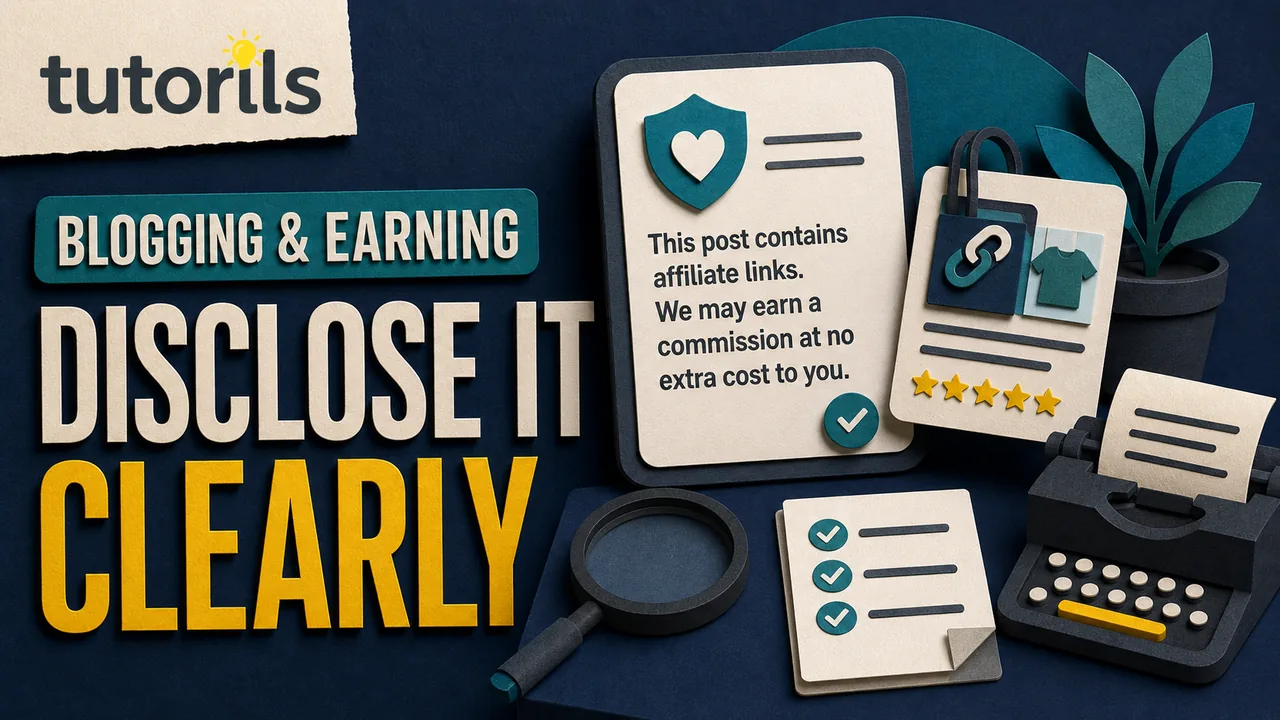
This article contains affiliate links. If you buy through them, Tutorils may earn a commission at no additional cost to you.
For a comparison where not every merchant is an affiliate:
Some links in this comparison are affiliate links. Tutorils may earn a commission from those links, but payment does not determine which options are included.
For a sponsored article:
[Company] paid for this article. The sponsor's involvement and the editorial review process are described below.
For a free review product:
[Company] provided this product at no charge for review. Tutorils kept editorial control over the findings.
Only use an editorial-independence statement when the workflow supports it. If a company approved the article, selected the talking points, or restricted criticism, explain that involvement instead of making a broad independence claim.
The Tutorils guide to affiliate marketing without a big audience explains why reader fit matters more than placing a large number of commercial links. A disclosure works best when it accompanies a genuinely useful recommendation.
Separate disclosure from persuasion
Do not surround the disclosure with promotional language. A notice that says "We may earn a tiny commission, so please support us" asks the reader to reward the publisher before evaluating the product.
State the relationship, then continue with the evidence. Explain who the product suits, who should avoid it, what was tested, which limitations remain, and what alternatives exist.
The disclosure should not be the only sign of a fair review. Strong editorial practice also includes:
- criteria decided before comparing products
- current prices and terms checked at review time
- drawbacks placed near benefits
- evidence for factual claims
- alternatives that may not pay a commission
- corrections when a product or program changes
The guide on making money with affiliate marketing without a large audience covers a smaller, trust-based approach. A publisher should never treat disclosure as permission to make exaggerated claims.
Explain the link without interrupting every sentence
A page with many affiliate links does not need the full notice repeated after every sentence. Repetition can make the disclosure harder to read while adding little clarity.
Use one prominent notice before the first commercial recommendation. Then use a consistent label on product cards or buttons when helpful, such as Affiliate link. Link the short notice to a full affiliate-disclosure page that explains how the site selects products, how commissions work, and how readers can report a concern.
The detailed page should answer:
- which types of relationships the site uses
- whether commissions can vary by merchant
- whether affiliate relationships affect product prices
- how editorial decisions are separated from commercial administration
- how gifted products and sponsorships are handled
- how old articles and broken links are reviewed
- how readers can contact the publisher
Keep the important relationship on the article itself. The detailed page provides context; it should not become a hiding place.
If the site is still being built, the Tutorils guide to starting a WordPress blog can help establish the publishing foundation before commercial modules are added. Put the disclosure component in the article template, but allow editors to select wording that matches each relationship.
Handle tables, buttons, and product boxes carefully
Commercial modules can draw more attention than ordinary paragraphs. That makes nearby disclosure especially useful.
Label paid placement as paid placement. Do not make an advertisement look like an independent ranking. If an affiliate program pays the same commission regardless of which product is chosen, that fact does not prove the ranking is independent. Independence depends on the editorial process.
Buttons should describe the destination, such as Check current price at [Merchant], rather than promising a discount that may have expired. If a price can change, say so near the price. Do not write "best price" unless the publisher has a reliable method for checking the relevant market at that time.
Google's guidance on qualifying outbound links says paid links should use the appropriate rel value, such as sponsored. This technical attribute helps describe the link to search systems. It does not replace the visible disclosure for readers.
Write for mobile and assistive technology
Check the article on a narrow screen. A notice that appears beside a product table on desktop may move below the buttons on mobile. Sticky menus, cookie notices, and ad placements can cover a disclosure even when the source order is correct.
Use a readable text size and sufficient contrast. Let the text wrap. Do not place the disclosure in a carousel slide that disappears automatically. If the notice uses an icon, keep the full explanation in text.
For audio and video, disclose the relationship in the content when practical, not only in the description. Captions should include the spoken disclosure. For a live session, repeat it when a new sponsored segment begins or when late viewers may otherwise miss it.
Read the sentence aloud. If it sounds unnatural or evasive, simplify it.
Avoid promises the program cannot support
Affiliate terms can change. A merchant may alter commission rates, cookie periods, eligible products, regions, or payment rules. The disclosure does not need to reproduce the contract, but the recommendation should not promise a benefit that the program does not guarantee.
Check the destination before publication and during later reviews. Remove or replace links that redirect unexpectedly, open an unavailable product, or lead to a different merchant than the text names.
The article on updating older blog posts provides a practical review process. Use the same discipline for disclosures: check the relationship, wording, destination, product status, and review date. Do not change the article date merely because an automated link checker ran.
Keep a disclosure record
For each commercial article, record:
- the affiliate program or sponsor
- the type of benefit
- the disclosure version used
- where it appears on the page
- the date the relationship was verified
- the editor who checked it
- the date of the next review
- any restriction imposed by the partner
This record helps when a program ends or an article changes owner. It also prevents a writer from copying a disclosure that no longer describes the relationship.
Use a disclosure status in the editorial checklist. The choices might be not commercial, affiliate, gifted product, sponsored, or other relationship requiring explanation. Require a reviewer to confirm the choice before publication.
Test the wording with someone outside the workflow
Ask a person who does not work with affiliate programs to read the disclosure and answer two questions:
- What does Tutorils receive if you use the link?
- Did you understand that before reaching the first recommendation?
If the person cannot answer, rewrite or move the notice. Do not coach the tester with an explanation that readers will never see.
Test the page without styling and with keyboard navigation. Check that the detailed policy link has descriptive text. If the disclosure is loaded by a script, confirm that it still appears when the script is delayed or blocked.
Reader research can reveal unfamiliar commercial terms. The Tutorils guide to keyword research for new bloggers explains how to collect reader language without stuffing repeated phrases into the page. Use that language to clarify the notice, not to make it promotional.
Review legal and platform requirements separately
Publisher, consumer-protection, advertising, tax, and platform rules are not identical. A disclosure that satisfies one platform's interface may not satisfy the law that applies to the audience. Requirements can also differ for children, financial products, health claims, contests, and regulated services.
Use the official regulator and platform guidance for each market. Seek qualified legal advice when the relationship, claim, or audience creates material risk. Do not copy another publisher's notice and assume it fits the same arrangement.
Use a final reader check
Before approving an affiliate article, confirm that:
- the visible notice states the real benefit
- the wording is understandable without industry knowledge
- the notice appears before the first influential link or claim
- mobile readers can see it
- gifted products and sponsorships receive specific treatment
- product evidence and drawbacks remain independent of the disclosure
- paid links use the appropriate technical attributes
- the full policy page is current
- the destination links work
- the review record has an owner and date
A useful disclosure is short because the relationship is clear, not because details were hidden. Tell readers what the publisher receives, put the notice where it can inform the decision, and make the rest of the recommendation strong enough to stand without pressure.
Reader answers
Frequently asked questions
Open a question to read the answer. Opening another answer closes the previous one.
What should an affiliate disclosure say?
State the real benefit in plain language. For example, explain that the publisher may earn a commission if the reader buys through certain links. Add specific wording when a product was gifted or content was sponsored.
Where should I place an affiliate disclosure?
Place it before the first affiliate link or recommendation can influence a decision. A detailed policy page may add context, but it should not replace a clear notice on the article itself.
Is an affiliate disclosure page enough?
No. Readers should see the material relationship on the page containing the recommendation. Link to a detailed disclosure page for the site's broader commercial and editorial practices.
Can I write that affiliate links cost readers nothing?
Avoid saying a purchase costs nothing. If accurate, say the commission adds no additional cost to the buyer. The product or service still has its normal price.
Do free products need a disclosure?
Yes, when receiving the product could affect how readers interpret the review. State that the company supplied it and explain any involvement the company had in the content.
Should every affiliate link have the full disclosure beside it?
A prominent notice before the first recommendation may be enough for a normal article. Consistent labels on product cards can add clarity without repeating the full sentence after every link.
What does sponsored link markup do?
The rel sponsored attribute helps search systems understand that a link is paid or commercial. It does not replace the visible disclosure that informs readers about the relationship.
Can I use the word partner instead of affiliate?
Use it only when the wording clearly explains what the relationship means. Partner alone may not tell readers that the publisher can receive money, products, credit, or another benefit.
How often should affiliate disclosures be reviewed?
Review them whenever a program, merchant, product, article, or compensation arrangement changes. A recurring link and content audit can catch expired destinations and wording that no longer describes the relationship.
Do affiliate disclosure rules differ by country?
Yes. Requirements can depend on the audience, publisher, platform, product, and jurisdiction. Check the current guidance from the regulators and platforms that apply to your activity.